

Strategy and management
How powerful is your brand, really?
Using BAV to read what is happening beneath brand perception
A business can own a name, a visual identity and a large communications footprint without knowing how much power its brand actually has in people’s minds. The more useful questions are whether people perceive a meaningful difference, whether the brand is relevant to their lives, how highly it is regarded, and how deeply it is understood.
The classic Brand Asset Valuator (BAV), developed by Young & Rubicam, organises that diagnosis around four perceptions: Differentiation, Relevance, Esteem and Knowledge. Its value lies less in the four labels than in the relationships between them.
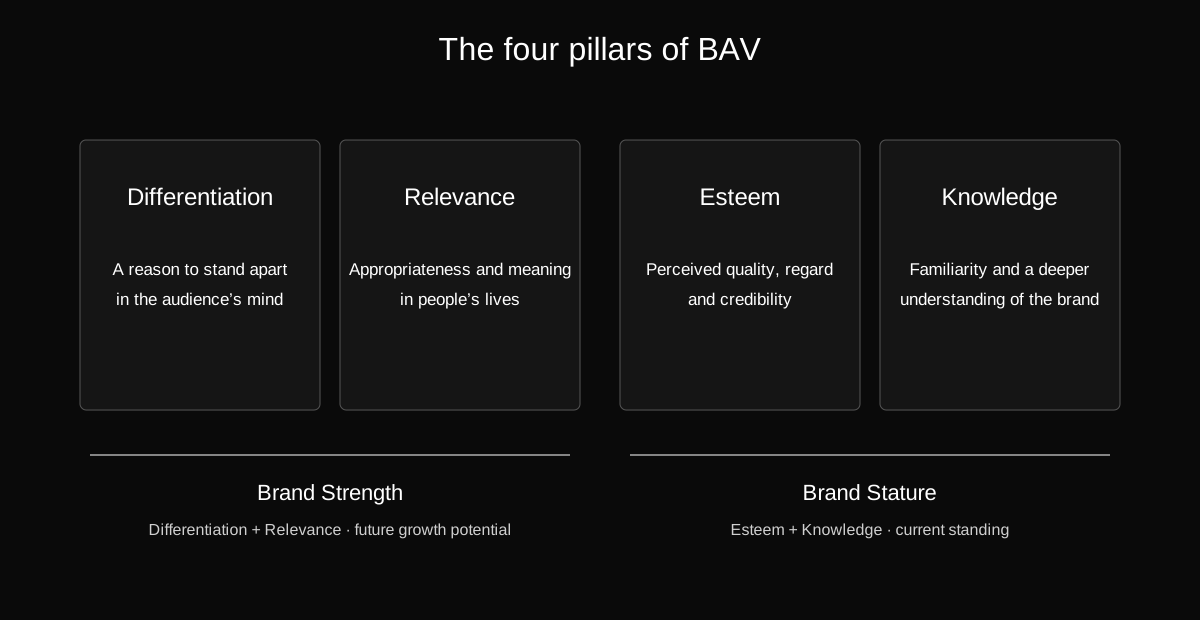
1. Differentiation: why should the brand be seen apart?
Differentiation is not simply visual novelty. It asks whether there is a recognisable reason to separate this brand from alternatives. That difference can come from the offer, experience, philosophy, problem-solving approach or a cultural and behavioural choice. In my own account, sustainable differentiation is strongest when it grows from something authentic and can be reproduced across the business.
2. Relevance: does that difference matter to me?
A brand can be highly distinctive and still be irrelevant to much of the market. Relevance connects difference with people’s needs, lives and situations. It is where creative distinctiveness becomes strategic value: a difference must matter to someone in a particular context.
3. Esteem: is the brand worthy of trust and preference?
Esteem is built through perceived quality, credibility, delivery and experience. It cannot be bought simply by increasing share of voice. The brand needs evidence that makes its claims believable. Market experience answers communications and determines whether a promise becomes perceptual capital.
4. Knowledge: what do people actually understand?
Knowledge is not the same as name awareness. A brand may be famous while people remain unclear about why it exists, what makes it different or what it stands for. Deeper knowledge develops when experience and communications build a relatively stable understanding in memory.
Brand Strength and Brand Stature
BAV combines the pillars into two important dimensions. Brand Strength brings Differentiation and Relevance together and acts as a view of momentum and future growth potential. Brand Stature combines Esteem and Knowledge and describes more of the brand’s current standing in the market.
This distinction is strategically useful. A brand can have substantial stature, remaining widely known and respected, while its future strength weakens because it no longer creates meaningful difference. Sales and fame may still be present while erosion has already begun beneath the surface.
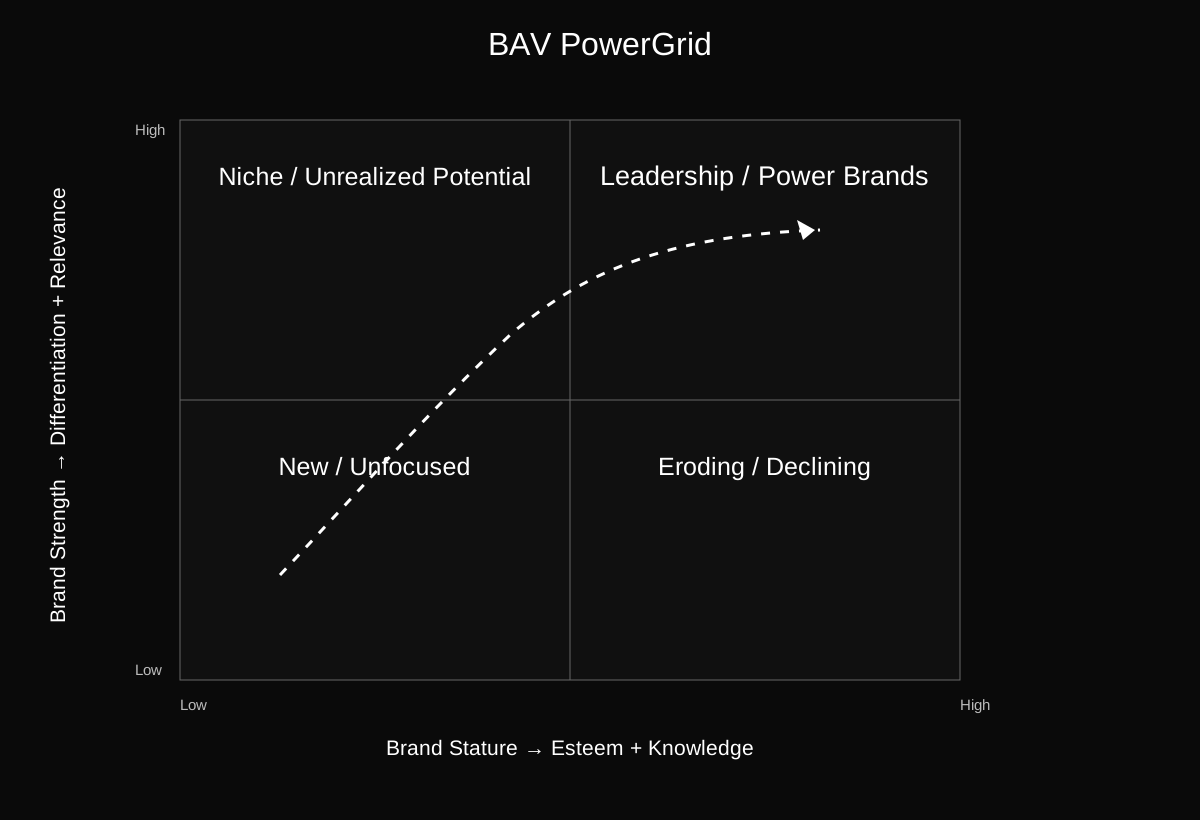
Reading the PowerGrid
New or unfocused brands sit toward the lower-left: neither strength nor stature is yet established. Movement upward indicates emerging differentiation and relevance. Brands with high strength but lower stature may be niche players or brands with unrealised potential. High strength and high stature together indicate leadership.
The danger zone appears when stature remains high while strength falls. People know the brand and may still respect it, but the future reason to choose it is weakening. Past fame can conceal this condition from management.
An important distinction: BAV is not a financial valuation by itself
The name Brand Asset Valuator can suggest a direct monetary valuation. At this level, however, BAV is primarily a diagnostic system for consumer perception and brand health. Academic research has examined links between BAV attributes and financial-market outcomes, but converting perception into a monetary brand value requires additional financial models and assumptions.
What BAV adds to brand philosophy
I do not treat BAV as a substitute for brand philosophy or identity. It approaches the brand from the market inward and asks what the organisation has actually become in people’s minds. Philosophy and identity provide criteria from the inside out; BAV helps assess perception from the outside in. Together, the two perspectives reveal the gap between what the organisation intends to be and what the market has learned to perceive.
Low Differentiation does not automatically call for a new logo; the proposition, behaviour or positioning may be unclear. Low Relevance can mean the difference exists but does not matter to the intended audience. Low Esteem points back toward experience and delivery. Low Knowledge may simply mean the brand has not yet built enough shared memory and understanding.
From measurement to decision
The model becomes useful when measurement changes a decision. The four pillars should be read for a defined audience and against a relevant competitive set. Management can then distinguish root causes from symptoms. More awareness, for example, is not a cure for weak differentiation; it can simply expose the same weak difference to more people.
Brand power is therefore not a simple sum of four scores. Their relationship tells a story about trajectory: is the brand emerging, carrying unrealised potential, leading, or consuming the capital of its past? That question turns BAV from a checklist into a diagnostic framework.
This is an expanded edition of my earlier Persian note on Virgool. Further reading: WARC on BAV and Mizik & Jacobson on BAV attributes and financial value.